Last Updated: November 1, 2026
Quick Summary
Avoiding hidden costs in fleet repairs means controlling every step: require itemized estimates, set written approval tiers with dollar caps, and demand written change orders before extra work proceeds. Audit each invoice against the approved estimate, work order, and warranty terms, then dispute any line that does not reconcile in writing before paying.
- A vague estimate is the most common source of surprise charges, so never approve work a shop will not itemize.
- Set approval tiers with hard dollar caps so no single person can authorize an open-ended repair.
- A verbal go-ahead is the most common source of disputed charges; require written change orders instead.
- Match the approved estimate, work order, invoice, and warranty terms before paying any bill.
- Choose shops on parts sourcing, labor warranty, and a written service-level agreement, not just price.
Table of Contents
- Why Hidden Costs in Fleet Repairs Start Before the Wrench Turns
- Step 1: Build a Fleet Repair Estimate Checklist Before You Approve Anything
- Step 2: Set Repair Authorization and Change-Order Controls
- Step 3: Audit Every Invoice and Dispute Charges That Do Not Match
- Step 4: Use Preventive Maintenance for Commercial Vehicles to Stop Emergency Repairs
- Step 5: Calculate Vehicle Downtime Costs So You Stop Underestimating Them
- Step 6: Track Cost Drivers With Fleet Maintenance Tracking Software
- Step 7: Choose Repair Shops on Parts Sourcing and Service-Level Agreements, Not Just Price
- Frequently Asked Questions
Why Hidden Costs in Fleet Repairs Start Before the Wrench Turns
Avoiding hidden costs in fleet repairs begins long before a technician touches a truck. According to Millennials Maintenance fleet maintenance statistics, 54% of fleet managers named managing preventive maintenance to avoid breakdowns or accidents as their top expense concern.
A repair bill lands, the number looks wrong, and nobody can trace where it grew. For a deeper look, see this guide to preventing unexpected box truck repair bills.
The core problem: most fleets treat fleet repairs as a transaction. The better approach treats every repair as a controlled process with checkpoints.
Step 1: Build a Fleet Repair Estimate Checklist Before You Approve Anything
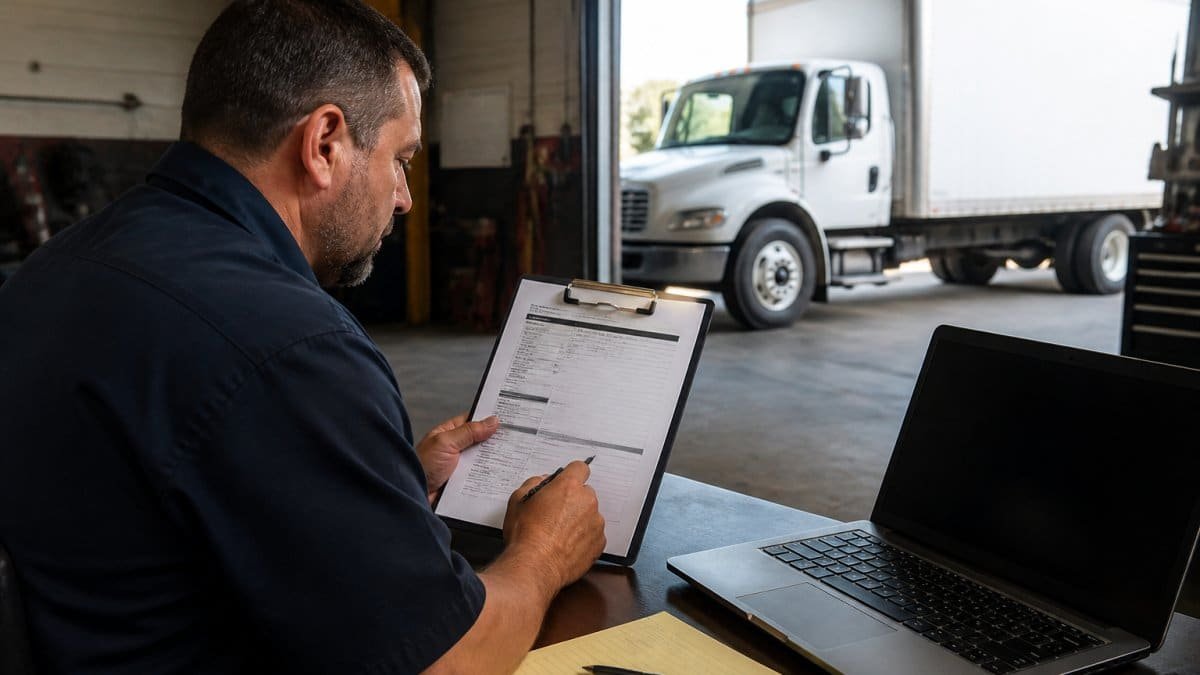
A fleet repair estimate checklist is a written set of items you confirm before authorizing any work. It forces the shop to itemize parts, labor, and fees so nothing appears later as a surprise.
What a Complete Estimate Should Itemize
- Part numbers, not just part names
- New, remanufactured, or used parts, stated plainly
- Labor hours and the shop’s hourly rate
Questions to Ask Before Signing Off
- Is this diagnosis confirmed, or suspected?
- What happens if the repair does not fix the issue?
- Are there related repairs that could wait?
Watch out: a vague estimate is the single most common source of surprise charges. If a shop will not itemize, do not approve the work.
Step 2: Set Repair Authorization and Change-Order Controls
Repair authorization controls are the written rules that decide who can approve work, up to what dollar amount, and how changes get approved. Without them, a small repair can quietly grow into a much larger invoice because someone said “go ahead” over the phone. This is the control layer most fleets skip, and it is where the largest surprise charges originate.
Set Approval Tiers With Hard Dollar Caps
Write the tiers down and post them where dispatchers and drivers can see them. A workable structure looks like this:
- Tier 1, Driver or dispatcher: routine items up to a low cap (for example, tires, bulbs, wiper blades, fluid top-offs). No diagnostic teardown, no parts ordering beyond the cap.
- Tier 2, Fleet manager: mid-range repairs up to a defined ceiling, including most scheduled maintenance and single-component replacements.
- Tier 3, Second signature: anything above the ceiling, any repair that requires opening the engine, transmission, or differential, and any job where the estimate exceeds the approved amount by more than a set percentage (commonly 10-15%).
The point is not the exact number, it is that no one person can approve an open-ended repair.
Require Written Change Orders Before Work Continues
A change order is a written record of added work, the reason for it, and the added cost, approved before the technician proceeds. Build three rules into every shop relationship:
- No verbal approvals. If a shop calls with “we found something else,” the answer is “send it in writing first.” A text or email with the added line items and price counts; a phone call does not.
- Document who approved what and when. Keep the approval attached to the work order so the invoice can be matched against it later.
- Cap the change order itself. If the added work pushes the job past the next approval tier, it goes back for a second signature, even if the original repair was already approved.
A verbal “go ahead” is the single most common source of disputed charges. If your shop cannot produce a written change order, you have no basis to dispute the added line, and the shop knows it.
Put the Rules in the Shop Agreement
Authorization controls only work if the shop agrees to them up front. Include the approval tiers, the written change-order requirement, and the rework terms in your service agreement or repair authorization form. A shop that resists written change orders is telling you something about how it bills.
Approval tiers plus written change orders turn every repair into a controlled process. The fleet manager who can point to a signed change order wins every billing dispute; the one who relied on a phone call does not.
Step 3: Audit Every Invoice and Dispute Charges That Do Not Match
Invoice auditing means comparing the final bill line by line against the approved estimate, the work order, and the warranty terms, then flagging and disputing anything that does not reconcile before payment. Most fleets glance at the total and pay; the money hides in the line items.
Run a Repeatable Four-Document Match
Before you approve any invoice for payment, pull four documents side by side:
- The approved estimate, what you authorized and at what price.
- The work order, what the shop recorded as performed, including any written change orders.
- The invoice, what you are being billed for, line by line.
- The warranty terms, what parts and labor coverage applies to this repair.
Every invoice line should trace back to an approved estimate line or a written change order. If it does not, it gets flagged. This match is the core of invoice auditing and the step most fleets skip.
Audit for These Specific Mismatches
- Labor hours above the quoted time. Compare billed hours to the estimate and to published labor time guides where available.
- Parts billed but not installed. Cross-check part numbers against the work order and, where practical, ask for the removed part.
- Duplicate fees across visits. Diagnostic fees, shop supplies, and environmental charges that reappear on every ticket add up fast.
- Charges for work never authorized. Any line without a matching approval or change order.
Dispute in Writing and Escalate in Order
When a line does not reconcile, dispute it in writing before paying. A workable escalation path:
- Send a written dispute citing the approved estimate or change order, the specific line, and the amount in question. Ask for a corrected invoice.
- Set a response deadline (for example, five business days) and state that payment on the undisputed portion will proceed while the flagged lines are resolved.
- Escalate to the shop manager or owner if the service writer does not resolve it, and reference the service agreement terms.
- Document the outcome and update your shop scorecard so repeat offenders lose volume.
If a bill is large and unexpected, learn how to qualify for truck repair financing while you sort out the dispute, but do not pay a disputed line just to close the ticket.
Keep a running log of every disputed line, the shop, and the resolution. Patterns emerge fast: one shop’s “shop supplies” fee, another’s diagnostic charge, a third’s habit of billing full labor hours on a job that finished early. That log is your negotiating leverage at renewal.
Invoice auditing is a four-document match plus a written dispute trail. Fleets that audit every invoice recover more in a quarter than they save on any single repair, and they stop the next surprise charge before it is billed.
Step 4: Use Preventive Maintenance for Commercial Vehicles to Stop Emergency Repairs
Preventive maintenance for commercial vehicles is scheduled servicing done on mileage or time intervals to catch problems before they cause breakdowns.
Build schedules around manufacturer recommendations, not guesswork. Track mileage-based servicing, sensor alerts, and inspections together.
Motive’s 2026 fleet maintenance roadmap notes that preventive programs are linked to lower annual costs, though results vary by fleet.
When you are ready to act on it, preventive maintenance services keep trucks on schedule instead of in the breakdown lane.
Step 5: Calculate Vehicle Downtime Costs So You Stop Underestimating Them
Vehicle downtime costs are the lost revenue and added expenses from a truck sitting idle. Most fleets underestimate them badly because they only count the repair bill, not the missed deliveries.
Use this formula:
Downtime cost = (revenue per truck per day × days out of service) + rental or replacement cost + driver idle wages That number changes how you prioritize repairs and how fast you need a truck back on the road.
Step 6: Track Cost Drivers With Fleet Maintenance Tracking Software
Fleet maintenance tracking software records every repair, part, and cost per vehicle so you can see patterns instead of guessing. Autosist’s guide to hidden fleet costs describes visibility as the foundation of cost control, and that matches what we see: fleets that centralize their data find repeat failures faster.
Track cost per mile, cost per vehicle, and repair frequency by unit. For small box truck operations, this guide to managing small box truck fleet maintenance ties tracking directly to your fleet type.
Step 7: Choose Repair Shops on Parts Sourcing and Service-Level Agreements, Not Just Price
Choose shops on parts sourcing, warranty coverage, and a written service-level agreement that states response times and rework terms.
Ask where parts come from, whether OEM or aftermarket, and what warranty backs the work. A shop that stands behind its labor will fix a failed repair without charging twice. Before you book anyone, use these questions to ask a mobile truck mechanic to vet the provider properly.
| Decision Area | What to Check | Why It Matters |
|---|---|---|
| Parts sourcing | OEM vs. aftermarket, stated upfront | Affects lifespan and warranty |
| Labor warranty | Rework covered, in writing | Prevents double charges |
| Response time | SLA with hours stated | Cuts downtime costs |
| Estimate process | Itemized, written approval | Blocks surprise charges |
| Diagnostics | Confirmed, not guessed | Avoids wrong repairs |
Frequently Asked Questions
What are the most common hidden costs in fleet repairs?
The biggest ones are charges that never appeared on the original estimate: added labor hours, upgraded parts you did not approve, shop supply fees, and diagnostic time billed twice. Emergency repairs also typically cost more than planned work. Lost revenue from downtime is the cost most managers forget to count. A written estimate, an approval threshold, and an invoice audit catch most of these before they hit your budget.
How can preventive maintenance for commercial vehicles reduce fleet repair costs?
Scheduled servicing catches worn brakes, tires, and fluid leaks while they are still cheap to fix. Follow manufacturer recommendations and mileage-based servicing intervals rather than waiting for a sensor alert. Keep every service record so warranty claims and recall repairs stay covered instead of becoming your expense.
What should a fleet repair estimate include?
A usable estimate lists the diagnosis, every part by name and part number, whether it is new or remanufactured, labor hours at a stated rate, and any shop fees. It should also state what happens if the technician finds more damage mid-job. Ask for the change-order process in writing before you approve. If a shop will not itemize parts and labor separately, treat that as a warning sign and get a second quote on the same scope of work so you are comparing like for like.
How do vehicle downtime costs add up beyond the repair bill?
A truck in the bay is not earning. You still pay the driver, the insurance, and the financing while missing deliveries or turning down jobs. Calculate your own cost per mile and multiply by the miles a vehicle misses. That number usually dwarfs the repair invoice and justifies paying for faster turnaround or mobile service.
Surprise repair bills rarely come from bad luck. They come from loose approval rules, unaudited invoices, and shops chosen on price alone. True Care Truck Services helps fleets close those gaps with ASE-certified technicians, 24/7 mobile and shop repair, transparent upfront pricing, and flexible 6-12 month interest-free financing. Get started with True Care Truck Services and keep your trucks earning instead of sitting.