
Table of Contents
- Why Box Truck Repair Bills Catch Owners Off Guard
- Your Box Truck Preventive Maintenance Checklist
- Warning Signs You Should Never Ignore
- Reducing Truck Downtime When Something Breaks
- How to Read and Approve a Repair Estimate
- Truck Repair Financing Options That Protect Cash Flow
- Building a Repair Budget and Tracking Maintenance Records
- Conclusion
- Frequently Asked Questions
Last Updated: October 22, 2026
Why Box Truck Repair Bills Catch Owners Off Guard
A box truck repair bill rarely arrives at a good time. It shows up mid-route, on a Friday afternoon, or the morning of your biggest delivery day. And it almost always costs more than you planned.
The problem is not that trucks break. The problem is that most owners treat repairs as random events when many of them are predictable.
This guide covers how to prevent unexpected box truck repair bills in 2026, starting with the daily habits that catch problems early.
The Real Cost of a Mid-Route Breakdown
A breakdown costs far more than the repair itself. You pay for the tow, the lost delivery window, and the driver’s wasted hours. You may also need a rental truck to keep routes running.
Then there is the cash flow hit. A repair bill lands all at once, while the revenue that truck would have earned disappears for days. For an owner-operator, that one-two punch can be brutal.
The Federal Motor Carrier Safety Administration sets roadside inspection standards that make breakdowns even riskier for commercial trucks. A truck that fails inspection stays parked until it is fixed.
Ignoring a small coolant leak or a soft brake pedal does not save money. It moves the cost from a cheap fix today to a towing bill and major repair next week.
Your Box Truck Preventive Maintenance Checklist
A box truck preventive maintenance checklist is a written set of inspections and service tasks performed on a fixed schedule. It catches wear before it becomes a failure. The checklist below is organized by daily, weekly, monthly, and mileage-based tasks so nothing falls through the cracks.
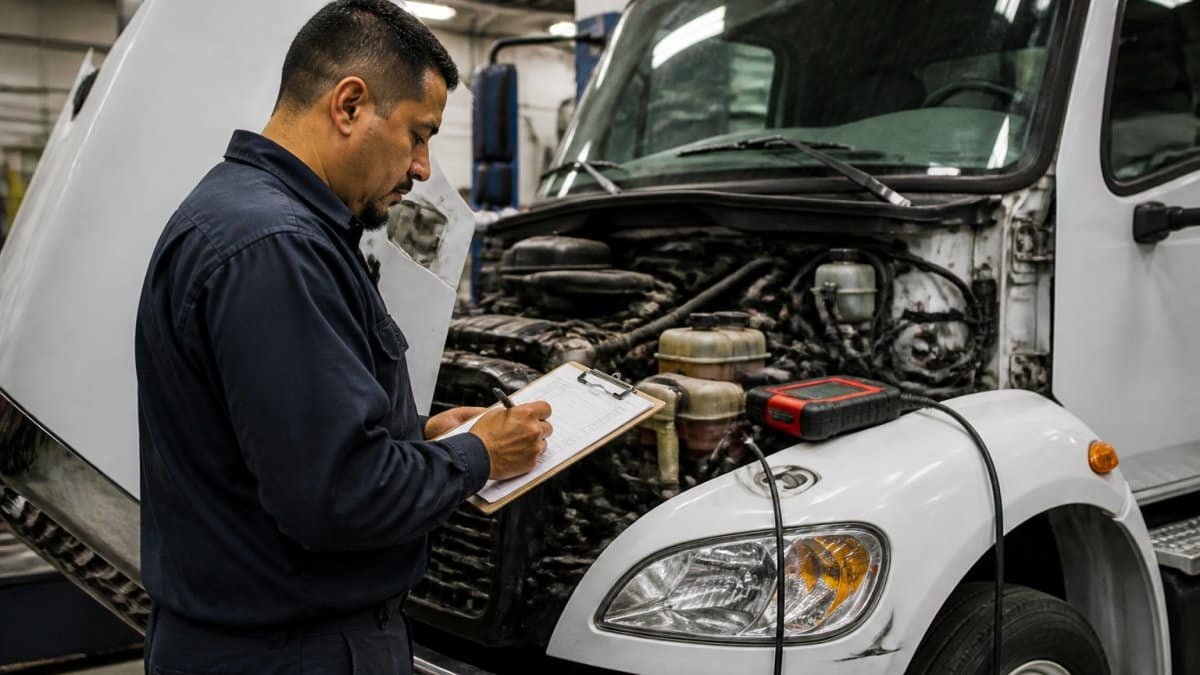
Daily Pre-Trip Inspection (10 Minutes)
Ten minutes before the first route of the day prevents most roadside surprises. Walk around the truck and check:
- Tire tread depth and sidewall damage
- Oil level and coolant level
- Brake pedal feel and air pressure build-up
- All lights, including brake and turn signals
- Windshield, wipers, and mirrors
- Fluid leaks under the truck
- Cargo door latches and lift gate operation
Log anything that looks off. A daily record gives your mechanic a head start when something does fail.
Weekly and Monthly Service Intervals
Daily checks catch sudden problems. Scheduled service catches slow wear. Here is how we break it down:
| Interval | Tasks | Purpose |
|---|---|---|
| Weekly | Tire pressure, fluid top-offs, belt and hose visual check | Catch leaks and pressure loss early |
| Monthly | Brake inspection, battery test, filter review | Prevent brake and electrical failures |
| Every service interval | Oil and filter change, chassis lubrication, diagnostic scan | Follow the manufacturer’s schedule |
| Seasonal | Cooling system flush, battery load test, HVAC check | Prepare for temperature extremes |
Stick to the manufacturer’s service interval for oil changes and major components. Skipping one interval to save money usually costs more later.
Mileage-Based and Duty-Cycle Adjustments
A box truck that runs stop-and-go delivery routes wears differently than one that cruises highway miles. Tailor your intervals to the duty cycle:
- Stop-and-go delivery: Shorten oil change intervals by 20-30% and inspect brakes monthly. Frequent starts and stops accelerate brake and transmission wear.
- Heavy loads: Check suspension, tires, and driveline components more often. Load weight stresses springs, shocks, and u-joints.
- Long idling: Increase oil analysis frequency and watch for carbon buildup. Idling degrades oil faster than highway miles.
- Severe weather: Inspect undercarriage for rust, test battery capacity, and check coolant strength before seasonal changes.
Use the owner’s manual as your baseline, then adjust based on how the truck is actually used. A truck that idles eight hours a day needs different care than one that runs 300 highway miles.
Building a Maintenance Log That Works
A simple log turns preventive maintenance from guesswork into a system. Record the date, mileage, task performed, and any symptoms noted. Keep it in the cab or in a shared spreadsheet. At each service, review the log with your mechanic to spot patterns, recurring brake noise, repeated coolant top-offs, or a battery that keeps testing weak. Patterns reveal developing problems before they become breakdowns, and a complete log supports warranty claims and resale value.
Set calendar reminders for weekly and monthly tasks. A written schedule only works if someone actually checks it.
Warning Signs You Should Never Ignore
Some warning signs mean “schedule service soon.” Others mean “stop driving now.” Knowing the difference is what separates a cheap fix from a costly repair.
Watch for these red flags:
- Dashboard warning lights that stay on, especially check engine or brake lights
- Fault codes stored in the diagnostic system, even if the truck seems fine
- Brake noise such as grinding, squealing, or a soft pedal
- Overheating or temperature readings climbing above normal
- Coolant leaks or a sweet smell under the hood
- Cooling fan that runs constantly or not at all
- Fluid spots under the truck after it sits overnight
- Vibration or pulling while driving
A grinding brake is metal on metal. That means new rotors, not just pads. An ignored coolant leak can warp a cylinder head, turning a hose replacement into an engine repair.
Ask your mechanic to run a full diagnostic scan at every service, even when no light is on. Stored fault codes often reveal a developing problem weeks before it becomes a breakdown.
Reducing Truck Downtime When Something Breaks
Reducing truck downtime starts before the breakdown happens. Build a response plan now, so nobody is scrambling at 2 a.m.
Here is the plan we suggest:
- Keep a roadside assistance number on file for every driver.
- Identify a mobile repair option that comes to your truck instead of requiring a tow.
- Line up a rental truck contact in advance for long repairs.
- Train drivers to report symptoms immediately, not at the end of the week.
- Track every breakdown so you can spot repeat offenders in the fleet.
Mobile repair changes the math. When a technician comes to your truck, you skip the tow fee and often get back on the road the same day. That is one reason our team runs 24/7 mobile service alongside our shop work.
The fastest way to cut downtime is to avoid the tow. A mobile repair call is almost always cheaper and quicker than towing a truck to a shop.
How to Read and Approve a Repair Estimate
A repair estimate should tell you exactly what is wrong, what will be fixed, and what it costs. If it does not, ask questions before you approve anything. The goal is to prevent surprise charges and unnecessary work, not just to compare the bottom line.
Use this checklist when you review an estimate:
- Written diagnosis naming the failed part and the symptom
- Parts listed separately from labor
- Labor hours stated with the shop’s hourly rate
- Diagnostic fee disclosed up front
- Warranty terms on parts and labor
- Any recommended “while we’re in there” work flagged clearly
Evaluating Labor, Parts, and Diagnostic Fees
Labor rates vary by region and shop type, but the estimate should always show hours multiplied by a stated rate. Ask whether the shop uses published labor times or estimates from scratch. For parts, ask whether they are OEM, aftermarket, or remanufactured, each has a different cost and lifespan. A remanufactured alternator may cost less but carry a shorter warranty. Diagnostic fees are common and legitimate, but they should be disclosed before work begins.
Getting a Second Opinion Without Delaying Repairs
For repairs above a few hundred dollars, a second opinion is worth the time. Ask another shop to review the written diagnosis and estimate, not to re-diagnose from scratch. Many shops will do a quick review at no charge or for a small fee. If the second shop disagrees on the cause, ask both to explain their reasoning. A good shop welcomes the question. If the truck is undrivable, ask whether a mobile technician can provide a second opinion on site.
Warranty Terms and Comeback Policies
Ask what happens if the repair does not solve the problem. A reputable shop warranties parts and labor for a stated period and will re-diagnose a comeback at no charge. Get the warranty terms in writing on the invoice. If the estimate does not mention warranty, ask before you approve. Our ASE-certified technicians warranty their work.
Never approve a repair estimate that lists only a total price without itemized parts and labor. You cannot evaluate what you cannot see.
Truck Repair Financing Options That Protect Cash Flow
Truck repair financing options let you spread a large repair bill over time instead of draining cash in one hit.
The main choices are:
- Shop financing plans offered directly by the repair provider
- Business credit lines from your bank
- Equipment financing that bundles repairs with other fleet costs
- Repair reserve funds you build up in advance
Each has tradeoffs. Shop financing is fast and simple but usually covers only that shop’s work. A credit line is flexible but takes time to set up. A reserve fund costs nothing but requires discipline.
At True Care Truck Services, we offer 6-12 month interest-free financing on repairs. That keeps cash flow steady without adding interest to the bill. Ask about eligibility and terms when you book, so there are no surprises.
Small fleets and owner-operators who face a large repair bill and need to keep cash available for payroll and fuel.
Building a Repair Budget and Tracking Maintenance Records
A repair budget turns surprise bills into planned expenses. Track your spending for a few months, then set aside a monthly amount based on your actual history.
Here is how we would build one:
- Add up last year’s repair and maintenance costs per truck.
- Divide by 12 to get a monthly baseline.
- Add a buffer for one major repair per truck per year.
- Review quarterly and adjust as the fleet ages.
Maintenance records matter just as much as the budget. Keep every repair invoice, service log, and diagnostic report in one place. Good records help you spot repeat failures, prove service history at resale, and support FMCSA maintenance recordkeeping requirements for commercial vehicles.
Pair the budget with a written maintenance program. A program sets the schedule; the budget funds it. Together they keep repair costs predictable.
Conclusion
Unexpected repair bills come from problems nobody caught in time. Daily inspections, scheduled service, and a written budget change that. So does a repair partner who diagnoses honestly and stands behind the work.
True Care Truck Services provides 24/7 mobile and shop repair for diesel, box, and semi-truck fleets, backed by ASE-certified technicians and 6-12 month interest-free financing. Book an appointment and keep your trucks road-ready.
Frequently Asked Questions
What is a good maintenance plan for box trucks?
A good plan combines daily pre-trip inspections with scheduled service intervals. Check oil, coolant, brakes, and tires every morning. Schedule oil changes every 5,000 to 7,500 miles, brake inspections every 25,000 miles, and cooling-system flushes every 30,000 miles. Keep written records for every service. A box truck preventive maintenance checklist tailored to your duty cycle (local delivery vs. long-haul) prevents small issues from becoming unexpected box truck repair bills.
Why are box truck repairs so expensive for small businesses?
Box truck repair costs add up because of parts, labor, and downtime. A single brake job can run $800 to $1,500, and a transmission replacement can exceed $5,000. Small fleets feel this more because one truck out of service means lost deliveries and rental costs. Without a maintenance program, repairs happen suddenly and at the worst time. Financing options and preventive maintenance help spread costs and reduce emergency spending.
How can I reduce fleet downtime and repair costs?
Start with a written preventive maintenance schedule and stick to it. Perform daily pre-trip inspections to catch fluid leaks, brake noise, and warning lights early. Track service records so you know when components are due. When a breakdown happens, have a roadside assistance plan and a backup rental truck option. Reducing truck downtime also means choosing a repair shop with ASE-certified technicians who diagnose correctly the first time, avoiding repeat repairs.
What are the most common warning signs of impending truck failure?
Watch for dashboard warning lights, especially check engine and coolant temperature. Listen for brake squealing or grinding, which signals worn pads. Check for fluid leaks under the truck (oil, coolant, or brake fluid). Notice any vibrations, unusual engine noises, or a soft brake pedal. Overheating, low oil pressure, and transmission slipping are red flags. Addressing these warning signs early prevents costly repairs and towing bills.
