Last Updated: October 25, 2026
Quick Summary
Emergency semi truck repair response times are the minutes between your call and a qualified tech reaching your truck, and they depend on where you are and what broke. Most fleets get quoted a range, not a promise, because a shop can be twenty minutes away and still take three hours to help you.
- A breakdown on a busy interstate exit gives a dispatcher more options than a narrow two-lane road with no lighting.
- Belts, hoses, clamps, batteries, alternators, tires, and brake chamber faults move fastest.
- Emissions codes, electrical gremlins, and driveline problems slow the clock before anyone turns a wrench.
- Park as far off the travel lane as possible with hazards on and set triangles or flares.
- Call for heavy-duty towing when the fault needs a lift, a bay, or a specialty tool.
Table of Contents
- What Drives Emergency Semi Truck Repair Response Times
- Mobile Semi Truck Repair: What Happens on Scene
- Your Roadside Truck Repair Checklist Before the Tech Arrives
- When Heavy-Duty Truck Towing Is the Faster Call
- Cutting Truck Repair Downtime After the Breakdown
- Common Mistakes That Slow Down an Emergency Repair
- Booking Emergency Semi Truck Repair for Your Fleet
- Frequently Asked Questions
What Drives Emergency Semi Truck Repair Response Times
Emergency semi truck repair response times are the minutes between your call and a qualified tech reaching your truck, and they depend on two things: where you are and what broke. Most fleets get quoted a range, not a promise.
Here’s the part most drivers learn the hard way. A shop can be twenty minutes away and still take three hours to help you, because the tech who knows your fault is on another job.
Location and Dispatch Distance
Where your truck sits matters more than anything else. A breakdown on a busy interstate exit with a wide shoulder gives a dispatcher options. A breakdown on a narrow two-lane road with no lighting narrows the list fast.
- Metro and industrial corridors: shortest dispatch windows, more techs in range
- Highway shoulders and weigh stations: moderate, depends on traffic and safe access
- Rural routes and construction zones: longest, because travel time and access both climb
Ask the dispatcher for a distance, not a feeling. “How far is the closest tech right now?” is a fair question.
Parts Availability and Truck Complexity
A blown coolant hose is a parts-cabinet job. A failed aftertreatment sensor or a wiring fault is a diagnostic job, and those take longer before anyone turns a wrench.
Common failure points that move fast:
- Belts, hoses, and clamps
- Batteries and alternators
- Tire and wheel issues
- Air line and brake chamber faults
Faults that slow the clock:
- Emissions and aftertreatment codes
- Electrical gremlins
- Transmission and driveline problems
A good mobile tech carries the fast movers. Nobody carries everything, so the honest answer to “how long” always includes a parts question.
Response time depends on where the truck sits and what failed, so here is how each factor moves the clock.
| Factor | Faster or shorter | Slower or longer |
|---|---|---|
| Location | Metro and industrial corridors | Rural routes and construction zones |
| Location | Highway shoulders and weigh stations | Narrow two-lane road with no lighting |
| Fault type | Belts, hoses, and clamps | Emissions and aftertreatment codes |
| Fault type | Batteries and alternators | Electrical gremlins |
| Fault type | Tire and wheel issues | Transmission and driveline problems |
| Fault type | Air line and brake chamber faults | Diagnostic jobs before anyone turns a wrench |
Mobile Semi Truck Repair: What Happens on Scene
Mobile semi truck repair is a service where a technician brings tools, diagnostics, and common parts to your truck instead of you limping it to a shop. The tech arrives, confirms the fault, and fixes what can safely be fixed on the spot.
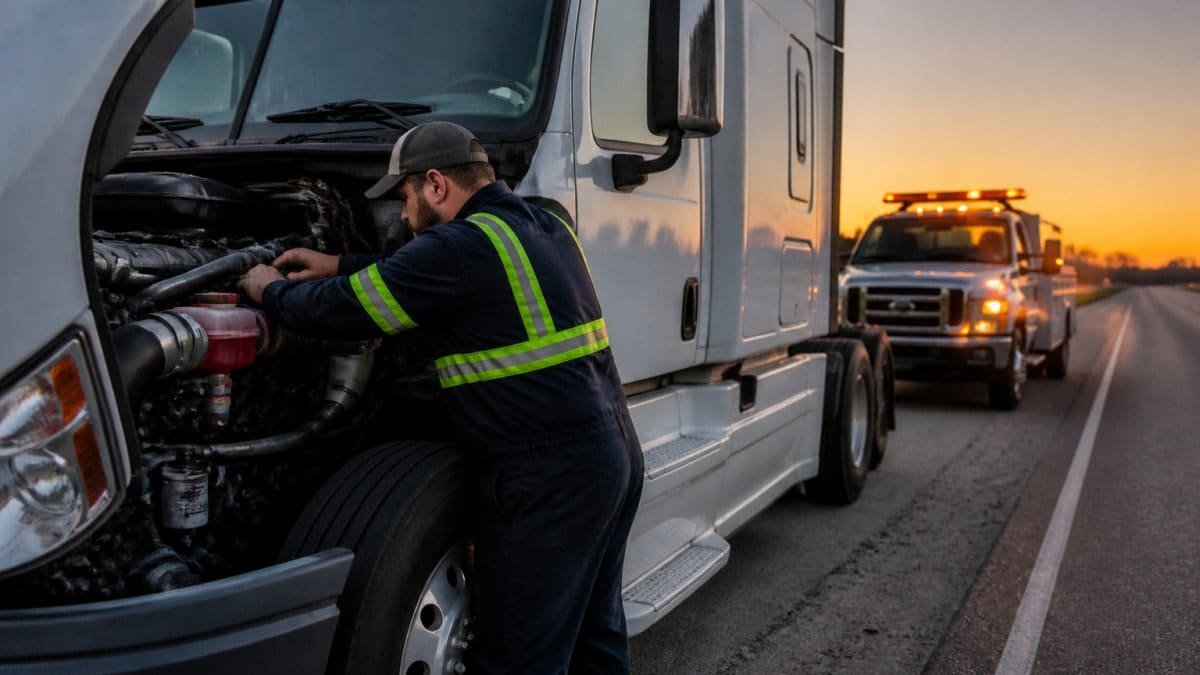
Here’s the sequence we run on scene:
- Safety setup first. Cones, lights, and a quick walk-around before anyone opens a hood.
- Scan and confirm. A diagnostic read to match the symptom to the actual code.
- Repair or escalate. Fix it on site, or tell you plainly that it needs a tow.
- Road test and sign-off. A short check before the truck rolls.
The point of mobile work is speed, but the point of a good mobile tech is knowing when to stop. See our services for the full range of on-site work a mobile tech can perform.
Your Roadside Truck Repair Checklist Before the Tech Arrives
A roadside truck repair checklist is the short list of things you do between the call and the tech’s arrival. Done right, it saves minutes. Done wrong, it costs hours.
- Park as far off the travel lane as possible, hazards on
- Set triangles or flares behind the truck
- Note the mile marker, exit, or nearest cross street
- Write down the symptoms in plain words
- Photograph any warning lights or visible damage
- Have your truck and fleet details ready for the dispatcher
- Confirm the tech’s ETA and call back if it slips
- Keep the driver clear of traffic and out of the repair zone
Watch out: drivers who move the truck to “a better spot” after calling often create a second problem. Tell dispatch before you move.
When Heavy-Duty Truck Towing Is the Faster Call
Heavy-duty truck towing is the right call when the repair cannot be done safely or quickly where the truck sits. Mobile repair wins most of the time. It does not win every time. Review the emergency roadside assistance offering to decide whether towing or mobile repair is the right call.
Call for a tow when:
- The fault needs a lift, a bay, or a specialty tool
- The truck is blocking a lane or sitting somewhere unsafe
- The repair needs parts nobody carries on a service truck
- The driver or cargo creates a time pressure a repair cannot meet
A tow that starts an hour earlier often beats a repair that finishes three hours later.
Cutting Truck Repair Downtime After the Breakdown
Truck repair downtime is the total hours your truck is out of service, not just the repair hours. That distinction is where fleets lose money quietly.
Downtime includes the wait for dispatch, the diagnosis, the parts run, the repair, and the return to route. Shave any one of those and the whole number drops.
What actually helps:
- Keep a fault log. Patterns show up fast when you write symptoms down.
- Service the fast movers. Belts, hoses, and batteries fail on a schedule.
- Fix small codes early. A cheap sensor today is a roadside call next month.
- Pick one provider. Familiarity cuts diagnosis time on repeat faults.
The Federal Motor Carrier Safety Administration publishes roadside inspection and out-of-service data that shows how often equipment faults pull trucks off the road. Prevention beats response every time.
Common Mistakes That Slow Down an Emergency Repair
The biggest mistake is a vague call. “It’s making a noise” sends a tech guessing, and guessing costs time. Say what you hear, see, and smell.
Other mistakes that add hours:
- Not knowing the exact location
- Moving the truck after dispatch
- Leaving the driver without a phone signal
- Skipping the safety setup
- Assuming the first quote is the final one
A common mistake is choosing a provider on price alone. The cheapest call is rarely the fastest one, and a slow fix costs more than a fair one.
Clear information up front is the single best way to shorten a repair. Browse FAQ and tips to avoid mistakes that delay a repair.
Booking Emergency Semi Truck Repair for Your Fleet
The best time to book emergency semi truck repair is before you need it. Fleets that pre-register their trucks and know their provider’s process get rolling faster than fleets that start from scratch at 2 AM.
What to set up now:
- Save the dispatch number where every driver can find it
- Note your common truck models and fault history
- Confirm what the provider carries on a service truck
- Ask about payment and financing before the emergency
We offer flexible 6-12 month interest-free financing so a surprise repair doesn’t blow the budget. Our ASE-certified technicians handle diesel, box, and semi-trucks, and we run mobile and shop service around the clock. You can book an appointment online, or call for emergency roadside help in the area when a truck is already down.
Frequently Asked Questions
How long does it take for emergency semi truck repair to arrive?
Arrival time depends on where the truck is, how far the nearest qualified technician is, and whether the shop has the right parts on hand. A well-run 24/7 service in a metro area typically dispatches a tech within a short window, but rural breakdowns and specialty parts add hours. When you call, ask for an honest arrival estimate and a callback if it changes. Confirm whether the tech carries common parts like belts, hoses, and filters so a simple fix isn’t delayed.
Can mobile semi truck repair fix a truck on the roadside, or does it always need a tow?
Many breakdowns are handled on the spot. Mobile semi truck repair units carry tools and common parts for batteries, air lines, belts, hoses, tire issues, and electrical faults. If the problem needs a lift, heavy internal engine work, or a part the tech doesn’t have, the job moves to a shop. Ask the dispatcher to describe what the tech can realistically fix roadside before you commit, and get the tow option priced at the same time so you can compare.
What should I include in a roadside truck repair checklist when I call?
Give the dispatcher your exact location with a mile marker or cross street, the truck’s make, model, and VIN, what the driver observed before the breakdown, any warning lights or fault codes, and whether the load is temperature-sensitive or hazardous. Note the safest place to park the rig and whether a lane is blocked. A complete roadside truck repair checklist cuts diagnostic time and helps the shop send the right tech with the right parts on the first trip.
How can fleet managers reduce truck repair downtime after a breakdown?
Keep a maintenance log per unit, track repeat faults, and pre-qualify a 24/7 repair partner before you need one. Store VINs, service history, and authorization limits in one shared document so dispatch doesn’t wait on approvals. Ask about financing options like 6-12 month interest-free plans to avoid delaying a repair over budget sign-off. Review truck repair downtime monthly by unit and route so you can spot the rigs that keep failing and schedule preventive work before they strand a driver.
A breakdown at 2 AM tests every process you built. If your fleet needs a partner who answers, shows up, and fixes it right the first time, True Care Truck Services is ready. Our ASE-certified techs, 24/7 mobile and shop repair, and interest-free financing keep your trucks moving. Get started with True Care Truck Services and cut your next repair down to size.